
Books, Apr-May 2026
Ecstatic visions, several varieties of People (Independent, Careless, etc), antimemes, creatures

Dear friend,
This is my second catch-up post following my new resolution to share more book reviews on this blog in 2026. (In case you missed them, see also On being a bookworm and Books, Jan-Mar 2026). Welcome!
Below are my responses to 11 books and one book series, which I’ve grouped less by genre this time and more by vibes: Ecstatic visions, Nature (only one this time), Books about People, and Speculative fiction/fantasy (okay that’s a genre, but some of the books are in that category based only on vibes). If you must know, there are 6 novels, one short story collection, one play, and 3 very different kinds of memoirs. And that 8-book (unfinished) series running entirely on charm and bookishness.
The most impactful books from this crop were the two ecstatic visions: Revelations of Divine Love by Julian of Norwich and The Passion According to G.H. I also particularly enjoyed There is no Antimemetics Division by qntm. But it was generally a very good couple of months of reading (including one very concentrated week while I was recovering from surgery).
Several books are very strong place-based entries: Independent People by Halldor Laxness, Strange Pilgrims by Gabriel Garcia Marquez, Voyage au Centre de la Terre by Jules Verne, and the Emma M. Lion series by Beth Brower. Runners-up include Regeneration by Pat Barker and The Backyard Bird Chronicles by Amy Tan. Impossible Creatures tries but falls a little short in my opinion.
As always, I would love to hear about your reading in return! (You can leave a comment on the post or reply to this email.)

Accounts of ecstatic visions
By complete serendipity, I fell into parallel reading of two books I never would have thought to pair, but which turned out to be fascinating foils: Revelations of Divine Love by Julian of Norwich (14th century, updated from Middle English), and The Passion According to G.H. by Clarice Lispector (20th century, translated from Portuguese). They are two ecstatic visions of the nature of reality through very different lenses, mystical divine love and existential horror—though the latter morphed into something closer to divine love than I expected, and the former had its share of grappling.

Revelations of Divine Love by Julian of Norwich
Format: ebook
How I came to this book: My reading group’s March theme was to read a book from the 14th century, and this one came highly recommended. (I finished it in May so am including it here.)
Review: This book was stunning—I wouldn’t have guessed I would find so much soul food in a medieval manuscript. TLDR: God loves his children, full stop, no if ands or buts.
Julian of Norwich was an anchoress, or a kind of religious hermit, whose personal details are otherwise lost to history, and yet thanks to her writings she has long been one of the most influential Christian mystics. Revelations of Divine Love, the earliest known English text attributed to a woman, is her account of and commentary on a series of visions she had some decades earlier during a near-fatal illness.
It took me a long time to read partly because I read the Project Gutenberg version which is a translation (from Middle English) from 1901 which kept a lot of the obscure vocabulary and syntax, and partly because it’s so metaphysically dense. It is rather repetitive, but in a sort of geometrical way; it would be interesting to map out the themes and phrases that Julian of Norwich builds out over the course of the revelations and commentary. And there’s real meat in there, not platitudes. Julian is grappling with all the suffering of mortality, the strictures of the medieval church to which she was devoutly loyal, and the limitations of human understanding, and finding noble equanimity in it all, driven by the conviction of what she saw and felt in her vision and learned about it over decades. So much of it resonated with me, and what felt less familiar was worth grappling with myself. I’ll definitely be returning to this.
And I saw full surely that ere God made us He loved us; which love was never slacked, nor ever shall be. And in this love He hath done all His works; and in this love He hath made all things profitable to us; and in this love our life is everlasting. In our making we had beginning; but the love wherein He made us was in Him from without beginning: in which love we have our beginning. And all this shall we see in God, without end.
Place factor: Only metaphysical glimpses of heaven and creation—all that is made, a hazelnut in the palm of her hand.
The Passion According to G.H. by Clarice Lispector
Translated from Portuguese by Ronald W. Sousa
Format: printed
How I came to this book: Clarice Lispector has long been on my radar as an Interesting Writer; my curiosity finally built up enough and this was the title I had come across the most.
Review: PHEW that was a difficult read. But an interesting one. My experience fluctuated fairly wildly between trying to decipher barely comprehensible (to me) metaphysical word salad; floating on waves of surreal, half-familiar feelings and images; and being pierced by moments of hard, glittering incisiveness. It had just enough sensory description and “organized” character context to anchor the metaphysical grappling and meandering, but not enough to give you sustained relief, and I think that’s how it’s supposed to feel (the narrator says as much). There were times when my brain felt so opened or transported by the language and ideas that I thought it would surely be a 5 star read, and then I would sink back into the mire. I think it requires multiple rereads to fully absorb, and it would certainly be rewarding, but it also sounds rather exhausting. I will read more by Lispector in any case.
Place factor: G.H.’s apartment building and its view into its own pipe-tangled courtyard and out over hot, glittering Rio de Janeiro is palpable, as is the stark, blank bedroom where the metaphysical ordeal takes place. G.H.’s mind and self is a whole other landscape, disassembled and reassembled by her vision.
Nature
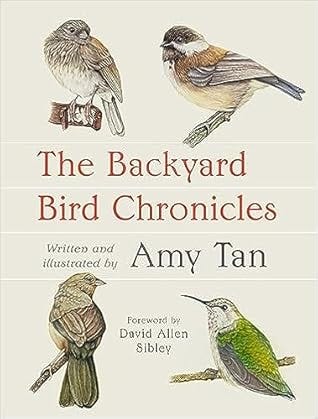
The Backyard Bird Chronicles by Amy Tan
Format: printed + audio
How I came to this book: I’m a fan of birds, art, and Amy Tan, had a recommendation from a friend, and saw it in the library.
Review: The highlight of this for me were the delightful and beautiful illustrations. As for the diary, I admired Tan’s enthusiasm, dedication and attentiveness to birds, but for me, despite (or maybe because of?) being a bird enthusiast myself, it was often rather boring.
Place factor: A nice portrait of Tan’s garden and what it contains of the ups and downs of seasons, wild visitors, and realities of nature such as disease.
Books about People
Yes, most books are about people in some form, but as two of these have
the word “people” in their titles (and another title names a specific kind of people), a category arose. A memoir, two novels, and a short story collection.
Careless People by Sarah Wynn-Williams
Format: audio
How I came to this book: It was everywhere in my feed, and the repeated accolades of its storytelling, on top of being a chilling expose by a former employee of Facebook, won me over.
Review: Wynn-Williams is indeed a great storyteller and is clearly intelligent and driven. Her insider view of Facebook is plenty damning, though I imagine most people reading already have a low opinion of the company (I actually googled “Does anyone like Mark Zuckerberg?” because at least in my bubble, his contemptibility is an undisputed meme). I learned a variety of new things to be dismayed and disgusted by, though I know it only got worse after she left in 2017, where the story ends.
Besides the piles of jaw-dropping anecdotes about her interactions with the senior management and the ridiculous lengths she went to in order to do their bidding, the main impression I was left with was incredulity that Wynn-Williams stayed so long. For all her relatively nuanced analysis of her bosses’ motives, her self-examination doesn’t go very deep—yes, she was idealistic and naive, she had a vision of what FB could be that was just utterly disconnected from reality, but I don’t think this can fully explain her willingness to put everything on the line for them again and again, to override her professed principles again and again. (Like, how did she stay married??) Major Devil Wears Prada vibes. There had to be some ego and career ambition at play beyond wanting to change the world and wanting to keep her healthcare and equity. Not that I needed her to throw herself under the bus; I just think it would have been more interesting to explore that more, and might have left fewer readers/reviewers scratching their heads about what was left unsaid.
At the same time, I wonder if she overstates her role in pushing Mark to be more invested in global policy, thus creating a monster who wanted more of the influence he finally started to understand. There’s no way to know from her story alone if he would have moved this direction anyway.
Beyond the details of FB’s transgressions, this was also an interesting look at how tech and governments operate across the world more generally. Her analysis of FB’s role in the unrest and atrocities in Myanmar was especially chilling, as well as the existential risks of data harvesting in authoritarian regimes. You just never know.
Place factor: Wynn-Williams successfully evokes a variety of places in her anecdotes, from the New Zealand beach where she almost died of a shark attack as a child, to the chaotic Silicon Valley FB headquarters, to the disastrous state dinner hosted among Panamanian ruins, to the oppressive government building in Myanmar where she miraculously managed to hitchhike in order to meet with the junta.
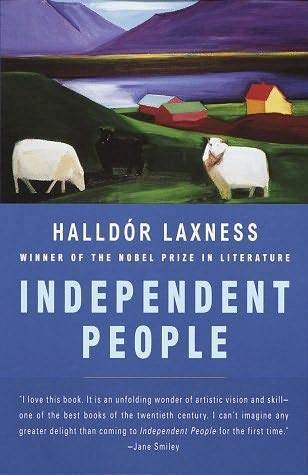
Independent People by Halldor Laxness
Format: audio
How I came to this book: I’ve been on a bit of an Iceland kick since visiting last year, and this book, one of the flagship novels of the most revered modern Icelandic author (and Nobel laureate) Halldor Laxness, also came recommended by a friend.
Review: This was a bit of a grind to finish within a two week library loan, but even if it sometimes felt like a chore, the writing was always arresting. It’s the kind of book where slice-of-life description and character do the heavy lifting, with only a few basic themes spelled out (“I’m an independent man” is repeated ad nauseam to the point of being stylized) and complexity filling the spaces between. Though more 20th century in style the overall vibe was very reminiscent of Thomas Hardy, only in Iceland. Sheep and Icelandic poetry feature heavily in the semi-satirical midst of early 20th-century Icelandic economic and political evolution. The landscape is evocative. Bjartur is tragically infuriating.
A few months later I can say the texture of the book is staying with me—the visceral grappling with nature and weather and death, the stink and grit of sheep, the thwarted longing for love between father and daughter. I’m hoping to read Under the Glacier soon, which I hear is weirder.
Place factor: This book is almost entirely place: Icelandic crofts frozen over half the year, sod roofs, gullies and hills and raging rivers, the alienness of town and wealth and the near legendary status of the rest of the world.
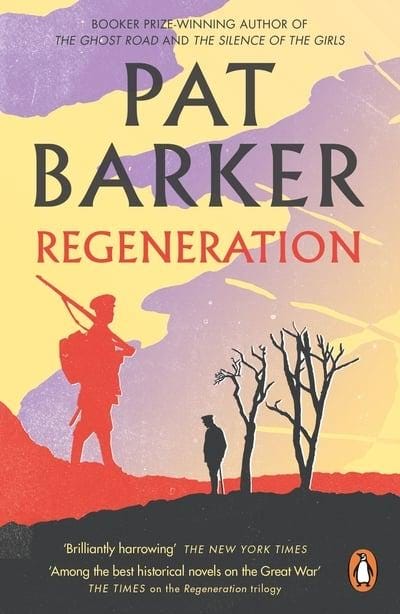
Regeneration by Pat Barker
Format: audio
How I came to this book: One of this year’s selections for Simon Haisell ’s slow readalongs at Footnotes and Tangents, which I’ve been following happily since its inception a few years ago. Simon’s weekly guides for the books we’ve read together (War and Peace, Hilary Mantel’s Cromwell trilogy, and a raft of smaller books, especially layered, introspective historical fiction) not only provide a wealth of thoughtfully compiled information and insight, but also evoke the spirit of each book with his empathetic prose. Highly recommend checking out Footnotes and Tangents on Substack!
Review: Regeneration is the first in a trilogy of historical fiction set during World War I, featuring the gentle, brilliant psychiatrist (and anthropologist) W.H. Rivers as he treats soldiers for war trauma, including Siegfried Sassoon (who’s actually been relegated there for publishing an anti-war manifesto), at Craiglockhart, a hospital in the countryside of Edinburgh. Whether historical or fictional, the people in this book are fully real. The writing is deft and economical, sojourning through the inner landscapes and turmoils of several characters to give us both immersive psychological and physical settings and nuanced exploration of war trauma and the ethical knots of war, society and relationships. An excellent book.
Place factor: I could physically, sensorily place myself in many of the places Barker evokes: the stifling country estate where the hospital is housed, the forays into the dark, wet forest for trysts and breakdowns, the crunch of shale and then the squelch of fish heads on a murky Suffolk beach, all too reminiscent of the trenches. The front itself is only present in memory and nightmare, which doesn’t make it any less brutally palpable.
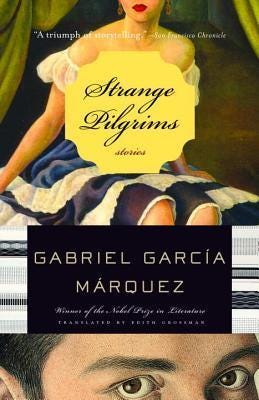
Strange Pilgrims by Gabriel Garcia Marquez
Format: printed
How I came to this book: I saw it on a display at the library, and in addition to being a fan of 100 Years of Solitude and curious about his short stories, the title was familiar from its namesake on Substack, a lit magazine I follow called Strange Pilgrims.
Review: This collection was conceived as one by Garcia Marquez: stores about Latin American expats in European countries. Most of these stories were highly readable, immersive, and some combination of melancholy and eccentric, and most were only lightly magical (if at all—though the ones without identifiable magic still had that unidentifiable strangeness and often violence). The longer, more developed stories were stronger than the short conceits. I enjoyed the detailed, sensual European settings, mostly familiar to me (as is the experience of living as a foreigner there), blended with the unfamiliar Latin American cultures and backstories of the characters.
Some of the more memorable stories included Maria dos Prazeres, Seventeen Poisoned Englishman, Tramonata, I Only Came to Use the Phone, and A Trail of Your Blood in the Snow.
Garcia Marquez’s prologue about how the project came to be is also interesting from a “writer’s life” perspective.
Place factor: Place is highly developed and central to the stories, the ghostly tug of the old countries and the concrete, ornate surround of the new.
Speculative fiction and fantasy
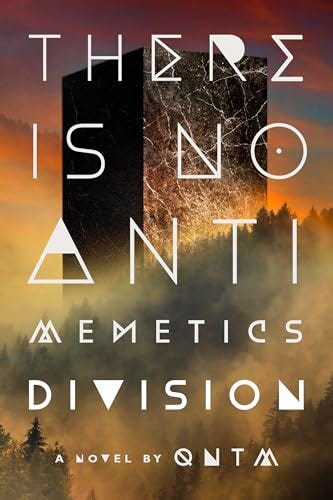
There Is No Antimemetics Division by qntm
Format: audio
How I came to this book: This book has been all over the feeds, but I swear I saw an offhand reference to it in another review and put it on my TBR before it took off.1 I had no familiarity with the online writing community/project that spawned it as a web novel (just glanced at the wiki before reading it for a bit of context); now it’s traditionally published as a standalone book, albeit a wild ride for the uninitiated (and preserving the author’s online name). In any case, I’m always looking for well-written, thought-provoking weirdness and this fit the bill.
Review: The premise of There is No Antimemetics Division requires some explanation: it starts with the secret Organization that contains “anomalies” (magic stuff, sci fi weirdness, infohazards) to protect the rest of the world, and this story centers on not the Memetics division, which deals with contagious ideas, ie memes, but the Antimemetics division, which deals with antimemes that, whether maliciously or not, erase things: people’s memories and even their effective existence. Hence high-up officials sometimes forgetting the division exists. And there’s one antimeme in particular that wants to take over the world, slowly revealed as layer after layer of collective memory is peeled back.
My reaction: that was fun! More archetypal and sentimental at its core than might be expected from the surreal trappings and liberal horror elements—a double hero’s journey with elements of tragic love story—but well-done, I thought. Great characters and scene writing, interesting ideas, moral weight. I enjoyed the technical puzzle elements of it even if a bit over the top. Excellent audiobook production.
Place factor: Hmm, yes, there are some interesting sci-fi bunkers and other technical landscapes, moody scenes like the one in which a new Anti-memetics recruit is introduced to a giant, hulking obelisk rising out of the forest that no one notices is there, horrorscapes such as an antimemetically infected hospital swarming with flesh-eating human hands, and truly apocalyptic landscapes bathed in interminable red light.
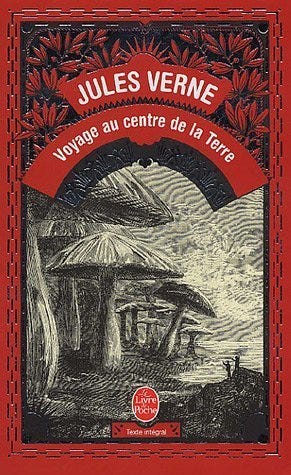
Voyage au Centre de la Terre by Jules Verne
(Journey to the Center of the Earth)
Format: ebook
How I came to this book: One of my book clubs decided to read this, and I jumped on the chance to practice my French by reading the original. It also happened to fit nicely in my Iceland kick, since it turns out Iceland is the gateway to the center of the world.
Review: This was a fun, doable read in French. It was a funny mix of science-inspired realism and fantasy, and a travelogue paced out like a real journey in the 19th century, where we don’t even get underground until halfway through the book because we have to get to Denmark and then Iceland and then overland to the volcano first (and describe all of it—effectively, I’ll add; I wouldn’t have guessed Verne never went to Iceland). Then we wander for a probably realistic number of weeks in dark tunnels with various setbacks but probably not enough mental suffering (only at moments of crisis), and THEN the fantasy begins. I quite like Verne’s hollow earth with all its attention to natural history; even if fantastical it was an interesting bit of sci fi worldbuilding. I was surprised at how brief the glimpse of it was, like a dream, and how vague the accolades they come back to are about what they actually saw. The story is mostly about their physical and emotional travails to get there and back.
The crazy, indefatigable geologist uncle is kind of annoying but a fun creation who grows on you, the narrator nephew is relatively sympathetic but also a bit dramatic, and Hans, the seemingly superhuman Icelandic eiderdown hunter who saves all their hides countless times, is almost the most unbelievable part of the book. (Second to their method of escape.) And it’s such a shame that Grauben, despite her flash of spirit at the beginning, is relegated to virtuous woman-left-behind. It could have been that much more interesting.
Place factor: Yep, this is an all-place book—in both real and fantastical ways, as described above. So much rock and darkness, but also Europe on one end, and the vast underground sea with its flickering electrical sky on the other.
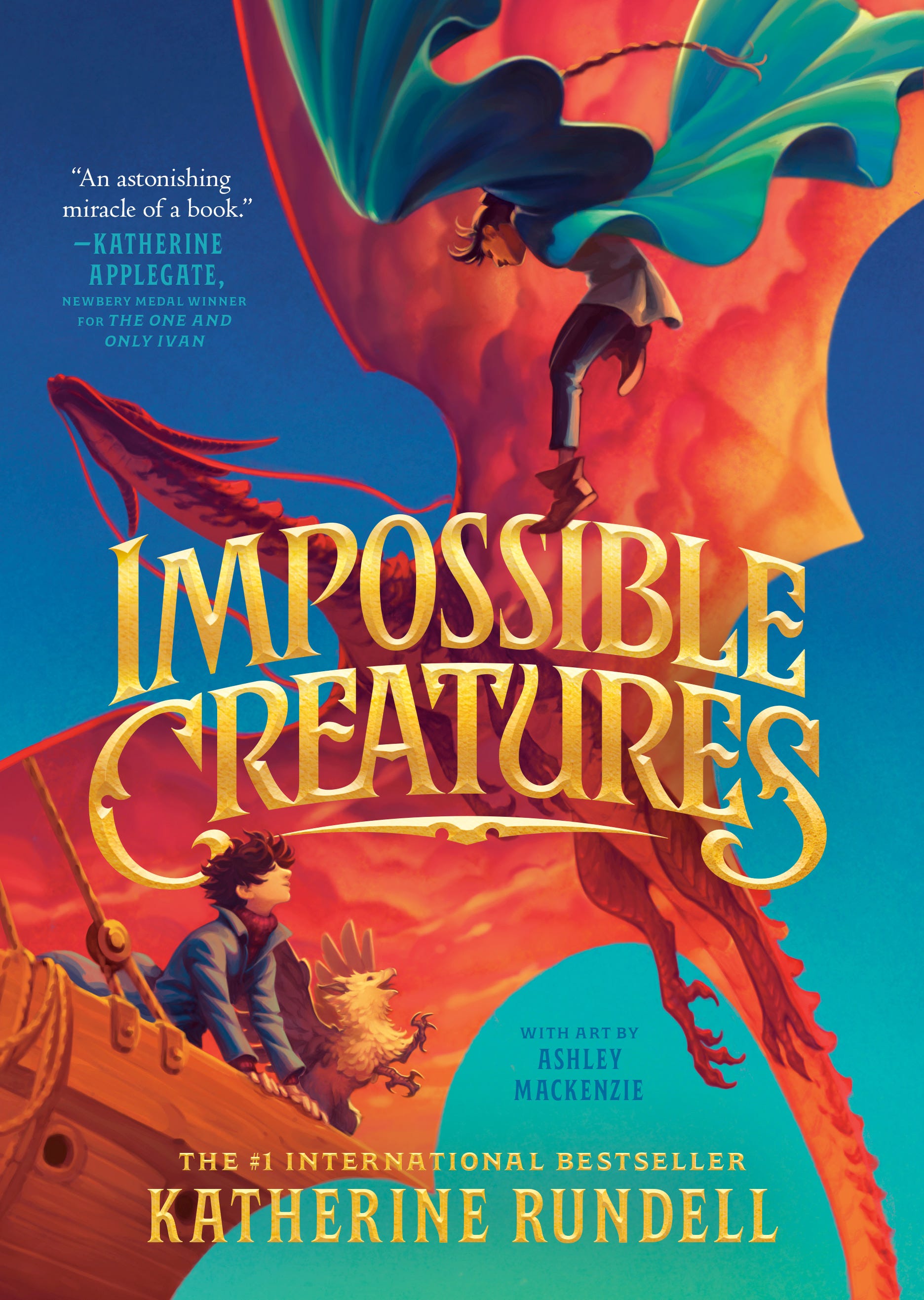
Impossible Creatures by Katherine Rundell
Format: audio
How I came to this book: Hyped by New York Times as an instant children’s fantasy classic, given the thumbs up by friends.
Review: A good story, supple prose, endearing characters, whimsical magic, strong heart, dark in a straightforward way. It’s great as a children’s book, but I can’t say that it reaches the level of depth or originality that I look for in a children’s book that is ageless and timeless, despite the hype suggesting this might be one of those. It’s notably derivative of Ursula K LeGuin’s Earthsea books, for one thing (an archipelago whose magic is fading because of the greed of one man who must be defeated by children of destiny?), and strongly archetypal without adding much complexity to those outlines. Nothing wrong with that, but it just didn’t touch me deeply.
I came across a nicely balanced review by Henry Oliver here.
Place factor: Rundell’s Archipelago full of magical creatures has nice outlines, but the characters’ journey through the islands feels a little like tracing a map with “here there be monsters” illustrations.
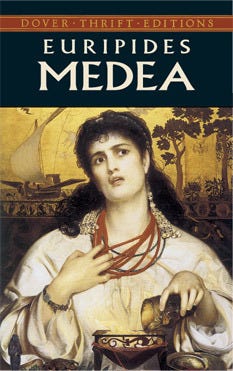
Medea by Euripides
Format: ebook
How I came to this book: My reading group’s theme for May was to read an ancient classic, and Greek plays are both excellent and short! Our resident Classics expert had a few recommendations and I chose Medea.2
Review: OOF that was devastating, and not a wasted line! I don’t even know what translation I had on Apple books, but it was masterful. So raw yet so elegant, an unmitigated cocktail of betrayal, rage, and regret. Medea’s emotional reality is fully legible as she vows to revenge herself on her husband Jason, who’s leaving her and their two children for a politically advantageous match and even shows up to rationalize/gaslight her pain away, and whose betrayal is so complete in her eyes that she will destroy everything rather than live with it.
Place factor: The leanness of a stage set: we never leave the outside of Medea’s house, although what happens offstage inside the house is just as significant, and both Medea’s forsaken homeland, where she gave up everything for Jason, and the new homeland (Corinth) from which she’s being exiled are present in the wings.
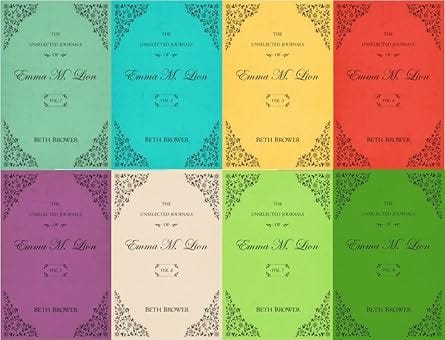
The Unselected Journals of Emma M Lion (#1-8) by Beth Brower
Format: audio
How I came to this series: Let me tell you, this series has been ALL up in my goodreads feed for at least the last year. It is what we might call a literary phenomenon. (The author lives in the next town over from me in Utah, so I’m not sure how much the popularity reflects my geographical/cultural range of friends, but I’m pretty sure the phenomenon has broken that boundary.) I was so annoyed by the title’s attempt at semantic cleverness3, plus my natural bandwagon-resistance, that I was determined not to read them for a long time. But I heard enough glowing reviews that I finally changed my resolution. (I read these, the 8 books published so far, from Feburary to June but am reviewing them together here.)
Review: Emma M. Lion is a spunky, bookish orphan-heroine of the Austen4 variety, living in a mildly Dickensian London with traces of magical realism.5 She loves wordplay, chafes at Victorian constraints on her autonomy, excels at getting into scrapes (especially reputational ones) and talking herself into chagrined silence, is very solid friend material, and has been through some things which she keeps at bay with clever cheerfulness and therapeutic walks with friends. The next most important character is her whimsical neighborhood, St Crispian’s, where, as a new adult, she’s come to claim her beloved family house and only financial asset. Emergent from St Crispian’s is a whole array of charming eccentrics who become her fast friends and frenemies. As a long (projected to 24 books) and slow-moving series, there is plenty of time for mysterious secrets, loves, and character arcs to stew; and in the meantime, shenanigans.
My goodreads reviews of the individual books show a clear pattern: the first was skeptical, the next few showed grudging appreciation, and by book 4 or 5 I was mostly won over (I officially declared my heart won by book 7). The remaining reviews have niggles, but I no longer felt the need to caveat my fondness for the characters, their world, and their shenanigans and emotional journeys.
My initial hesitations were the unremitting cleverness of the humor (see title) and the deliberate placement of historical details (such as mentions of the shiny new Edison’s telephone company and the recently demised East India Company in conversation) that feel like the author trying to convince me of something. The former still grates on me at times,6 but the latter has been forgiven because overall it’s quite adroit. In the meantime, I still have some ambivalence about the way Emma’s abundant male friendships take center stage; she has strong female friendships but they’re all secondary in the story, giving the series a slightly “not like other girls” sensibility. I don’t blame Emma for this, however.
It helps that, in addition to supremely fun story-telling, the characters are well-drawn, with their own distinct sets of mannerisms, flaws, endearing features, and reasons to root for them. (St. Crispians is the same way.) There is enough depth to their arcs and relationships to be genuinely emotionally involved.
The upshot is that the series seems to blend Victorian pastiche/historical fiction with a certain modern magic sauce that is reminiscent of eg an Emily Henry novel or romantasy, without being a full-blown romance and without totally blowing its historical cover. You know, the banter, the chemistry (passing notes through the wall is totally a stand-in for texting), the processing of feelings, the feminism, the quirkiness that all the men flock to. It kind of feels like it’s set in an alternate universe that strongly resembles Victorian England, but is injected with a modern American streak of fizz and wish fulfillment. The bookishness and literary allusions, another important lure for Brower’s audience I think, are laid on thick, but intelligently. It all hangs together smartly and charmingly, so once I recognized the parameters and settled into this cozy alternate universe, it works well enough for me to just have fun.
I recommend it pretty freely to anyone who seems to like Jane Austen and heartwarming and/or whimsical things.
Place factor: St. Crispians is a distinctive creation, and as I mentioned, central to the whole vibe. It has whimisically named streets like “Whereabouts Lane” and a square with lamps sculpted into fantastical shapes. Household objects tend to mysteriously disappear and reappear elsewhere in the neighborhood and are taken to the Read and Write shop to be claimed. Etc. Other London landmarks like Regents Park also make regular appearances. It all feels very much like a Place.
That brings us to the start of June, the current month, so I will figure out the rhythm of future recaps as I go. I’ve finished 2 books (and a graphic novella) so far in June and am doing the thing where I’m reading 5-6 books in parallel, looking at finishing most of them by the end of the month. \* rubs hands together greedily *
Happy reading!
I checked when I added it on goodreads, and it was indeed a couple of weeks before it was released by a traditional publisher in Nov 2025 (but several years after it was self-published). I think I started seeing it blow up in my feed a few months later.
Medea is cast as a sorceress/witch, so I’m including it in Speculative fiction, even though that’s really not the point of the story.
“Unselected” as opposed to “Selected”, presumably to indicate the journals unfiltered/unabridged in a sort of jocular tone.
It’s set in the 1880s, but I would say the vibe leans more Austen than Dickens. Not a direct pastiche of either, though.
The light magical realism is partly why I placed this series under speculative fiction, but perhaps even more because, like I say at the end of the review, it just feels like a fantasy world.
For example, one minor but very persistent tic that bugs me: the recurring joke where the second half of an ostensibly ambiguous two-part statement is amusingly misattributed and then corrected with a roll of the eyes. MY eyes, that is. “Islington’s footman came to invite me to dinner at his house. Islington’s house that is, not the footman’s.” This pattern recurs a ridiculously frequently. In general, people in this series are often more droll or eloquent (or pointedly INeloquent) than is believable. But there’s enough going on underneath to be forgiven.
So glad to see something else reading Julian of Norwich! I’m not finished yet but I’m in love.
Regeneration was made into a film. It's a book I must read. I have her book The Ghost Road on my tbr stack. I remember reading your article about Iceland and I plan to visit the country next your. You might like the books of Hannah Kent. Her fiction book Burial Rites is excellent. And her recent memoir, Always Home, Always Homesick, about her time in Iceland is very good. I reviewed it in my April Reads.