
Books, Jan-Mar 2026
Literary women, humanitarians, Darwin, Donne, melancholy short stories, dark whimsy

Dear friend,
Welcome to the first (catch-up) Anne of Green Places book post of 2026!
I started off the year on a nonfiction kick, after a year dominated by magical realism and dark fantasy in 2025. Or maybe it was more an everything-but-novels kick—I did read 2 standalone novels and 4 short novels from a series, but in a reversal of my usual proportions, the other 12 books were non-fiction, short stories, poetry, and illustrated anthologies. Seven of those were non-fiction, ranging from the 15th century to 2025.
It was also a library kick: I got a new library card soon after moving in January, and I was so excited to be back in range of an Anglophone library that I came home with several loads of books. As I mentioned in On being a bookworm, audiobooks are my bread and butter these days, but the library, with its printed riches and, crucially, its deadlines, whetted my appetite for the one-track work of reading a physical book every evening. By February, I deleted Instagram in part to make more room for this ritual.1

Of my January-March reads, the most impactful was On the Origin of Species by Charles Darwin. Not a light read or one that would appeal to everyone, but deeply meaningful for me. Jane Austen’s Bookshelf by Rebecca Romney is still resounding through my literary landscape (despite stylistic flaws), and a collection of poems by John Donne was deeply rewarding. Beautiful writing in I Am, I Am, I Am by Maggie O’Farrell and Winter’s Tales by Isak Dinesen; fascinating worldbuilding in The Goblin Emperor by Katherine Addison; delightful dark whimsy from Edward Gorey. I’ll let you read the reviews.
This might be over-formatted, but my organizing brain decided to give you several headings for each review: the format of my reading, how I came to this book (in case you’re curious), a review adapted from what I posted on goodreads at the time of finishing the book, and, in honor of the theme of this blog, the “place factor,”or the role and importance of place in the book (sometimes very little, sometimes central).
In this crop of books, the most place-centered ones were Gathering Moss by Robin Wall Kimmerer, The Ladies of Grace Adieu by Susanna Clarke, and Winter’s Tales by Isak Dinesen, and also featured in Edward Gorey, I Am, I Am, I Am and The Goblin Emperor.
Feel free to pick and choose which reviews to read, there are a lot! Meanwhile please do respond with book chats of your own. Have you read any of these? What else are you reading?

Nonfiction
Nature and Science
On the Origin of Species by Charles Darwin
Format: audio with some reference to printed
How I came to this book: One of the most foundational of founding texts of my discipline (evolutionary ecology) that I’ve long had on my shelf (I got my physical copy at the gift shop of Down House, Darwin’s house in Kent) but never actually read, until now. I think the triggering event was becoming a professor and feeling I couldn’t go on without reading it. Buckle up, this will be a long review.
Review: Magnificent. Reading this was akin to a spiritual experience for me. Granted, it’s long and long-winded (though only an “abstract”!), and I listened to it with fluctuating attention, so not a close study this time. But even when drifting a bit between details, I felt the significance and the familiarity of all of it. The principles that Darwin so meticulously teases out here are the rock and foundation of all my training, and beyond that, represent a framework for understanding the natural world that has, throughout my life and education, beautifully expanded my native wonder and curiosity from first-person encounters to the reaches of deep time.
Even if tedious at times for a modern reader, it’s good writing, a masterful enumeration of evidence and logic to flesh out this theory for a skeptical audience. That audience was a wide range of naturalists, scientists, and more general public with some knowledge of the natural world and the going arguments about its laws and origins. Imagine being on that threshold, when what is now such a fundamental layer of our picture of reality was just coming into focus, and the only alternative was to guess or fall back on myth. But creation ex nihilo of immutable species wasn’t even myth, it was effectively reality for Western science and culture. This book was a rewriting of reality. It still doesn’t convince everyone, but that’s not Darwin’s fault.
What especially struck me was how scientifically current so much of what he wrote still is. Through a lifetime of observation (from across the globe to his own backyard), experimentation, and synthesis of others’ observations across a huge range of fields (natural history, taxonomy, animal and plant husbandry, geology, biogeography, paleontology), he made elegant, fundamental sense of it all. There were large gaps in what was available to know, and he’s very up front about this. And yet so many of the gaps he describes point straight to whole fields that have unfolded since then. “Organisms inherit their traits somehow, but we don’t know how.” Enter genetics and DNA (and so recently!) “The earth must be very old to accommodate for the pace of evolution from one or a few ancestors, but we don’t know how to measure this.” Enter radiometric dating. “The continents must have once been in a very different position.” Enter plate tectonics (also recent!). I could go on. Darwin was able to hold space for all these missing puzzle pieces in their roughly correct places, and his framework is just as useful now as it was then in our puzzle quest.
I’ll insert here for anyone interested that I believe in God as a creator, and that I’ve never worried about reconciling that belief with the scientific tenets of evolution by natural selection. It’s how I was raised and it’s the field I went into, and I’m perfectly fine with seeing this as a mechanism God could have used. I believe God loves our curiosity about his world and the deep attention that understanding it in light of evolution allows and requires.
I actually tear up when I read the iconic final line, which gives you a taste of the feeling interwoven with Darwin’s careful reasoning:
“There is grandeur in this view of life, with its several powers, having been originally breathed into a few forms or into one; and that, whilst this planet has gone cycling on according to the fixed law of gravity, from so simple a beginning endless forms most beautiful and most wonderful have been, and are being, evolved.”
Place factor: a wide-ranging sense of the globe is definitely present here, delivered in snippets of zoomed-in anecdotes and abstract propositions of sweeping proportions.
Gathering Moss by Robin Wall Kimmerer
Format: audio
How I came to this book: I read Kimmerer’s Braiding Sweetgrass several years ago and have been curious about this earlier work ever since, especially as it relates to my own experience as a plant ecologist.
Review: Gathering Moss provides a highly accessible and delightful closer look at mosses through an array of lenses by someone who’s looked pretty darn close. I especially appreciated the narratives about her research and fieldwork starting from the point of inception of her questions, which always came from careful observation. I generally like her braided, personal writing style, though the essays that leaned on analogies with human relationships and activities felt a bit twee and heavy handed to me; I preferred when the human elements were directly related to her encounters with mosses and anthropological/cultural history. Some of the ideas in Braiding Sweetgrass about reciprocity are introduced here, which certainly strikes me as healthy for humans but I’m still a bit wary of the level of anthropomorphism involved. In general I thought the more philosophical parts of the books were rather simplistic; I’d have to reread Braiding Sweetgrass to see if they hold up better there (but I remember sometimes feeling ambivalent there as well).
Place factor: Kimmerer weaves place quite naturally into her accounts of encounters with mosses and their larger ecosystems. She maps in detail her sensory experience of pathways into hidden boulder grottos and moss curtains on the walls of slot canyons.

Literary women
The Book of the City of Ladies by Christine de Pizan
Format: audio
How I came to this book: I’m part of a book group that, rather than choose a book for us all to read, comes up with a theme every month and we choose our own books to fit the theme. For several months our project was to read our way back through the centuries, and January was the 15th century. I hadn’t heard of this book until looking up famous 15th century books, and when I saw it was a classic proto-feminist text, I went for it.
Review: The Book of the City of Ladies is a biographical catalogue of illustrious women, in which Christine de Pizan and her allegorical spirit guides build a metaphorical city for such women to take refuge on their own terms from the slander and verbal abuse of misogyny (specifically the slander perpetrated by male writers of the medieval and classical canon, less actual violence). It was fascinating to listen to devout, educated, articulate Christine de Pizan roasting misogynistic men and plugging women’s unmitigated potential for bad-assery (multiple chapters on Amazon warrior queens, etc), intellect, wisdom, steadiness, ability, etc as men’s equals if not superiors in many cases, while also fully buying into the patriarchal system as just the way things are—women should be grateful when their husbands are good and be long-suffering when they’re boors, and even though she concedes that women are PERFECTLY capable of being lawyers, the men are doing an adequate enough job in their sphere and we’ll leave it at that. Chastity, soberness and a good reputation are the highest virtues any good Christian woman can attain (the ones with loose morals won’t be admitted to our city). It tracks for a medieval writer who is both pushing the envelope for her time and working within the constraints of her time. But some of the roasts are so dang sassy—she totally knows a double standard when she sees one—it’s a let-down when the pious submission to the patriarchy comes back out.
It also definitely gets a bit long and repetitive, but the framing metaphor and rhetorical dialogue, along with the immersion in the array of characters and stories important to the medieval world, make a reasonably readable tour.
Place factor: Place in an abstract sense (the foundations dug, the bricks laid, the towers built story by story) is important to the book, but otherwise wasn’t a strong presence.
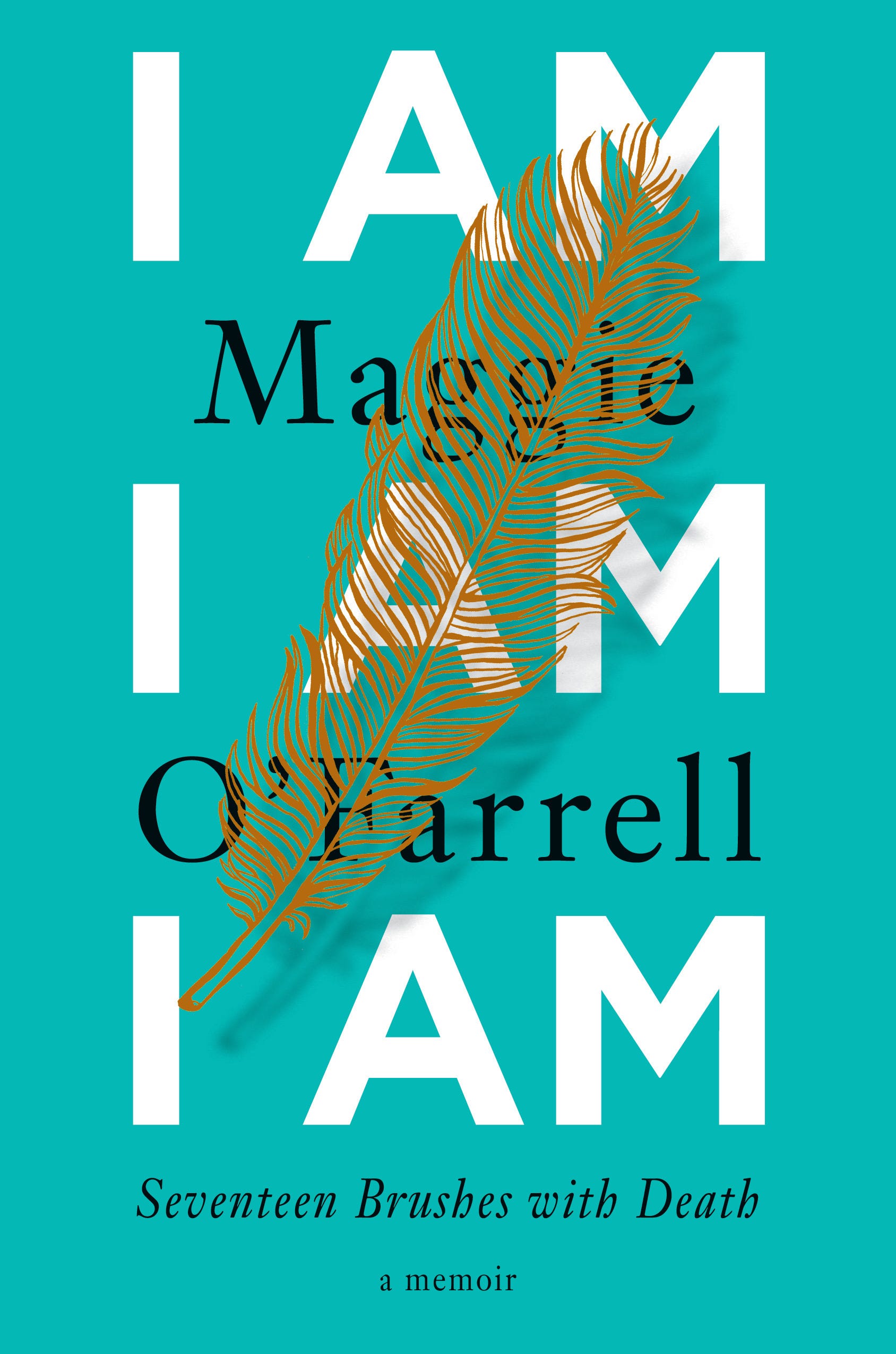
I Am, I Am, I Am by Maggie O’Farrell
Format: printed
How I came to this book: I was a big fan of O’Farrell’s Hamnet, less a fan of The Marriage Portrait, but I knew she can write so was curious about her essayistic approach to memoir. I got a hold of this copy from a neighbor’s Little Free Library.
Review: I Am, I Am, I Am is told in seventeen essays centered on near brushes with death. It’s a very moving collection, some more gut-punch and some more contemplative (and some maybe a stretch for the near-death theme). I was reduced to tears in the face of mortality and the potential for loss more than once.
Style note: O’Farrell’s writing is lovely, but I wish she wouldn’t lean quite so much on asyndeton (I learned that word in 8th grade English and yes I did have to look it up when writing this). Opening the book randomly it’s not hard to find an example: “I am suffused, preoccupied, distracted by the physical, the deafening noise of the aircraft, of people’s panic, the assaulting drag of the fall, the bracing of my body for the inevitable impact.” It’s not just the self-conscious commas, it’s the proliferation of words. I think I would prefer a tighter version. I know I milk words in my writing too so it’s a good reminder.
Place factor: O’Farrell is an expert evocateur of landscape, and several essays are very rooted in her native Irish, Welsh, and Scottish landscapes across different stages of her life, as well as travel in other parts of Europe. It’s been long enough since I read it that I can’t provide examples, but I have a vague sense of green hills and stultifyingly small port towns.
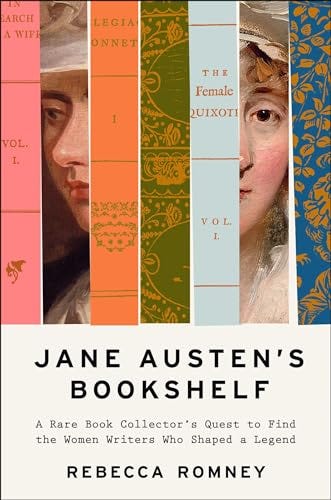
Jane Austen’s Bookshelf by Rebecca Romney
Format: printed
How I came to this book: It was on my radar from reviews and marketing, and as it was very much up my literary alley, I grabbed it as soon as I saw it while browsing at the library.
Review: Jane Austen’s Bookshelf is a hybrid work of literary criticism (loosely speaking) and memoir, in which a bookish rare bookseller tracks down books by female authors who were popular in Jane Austen’s lifetime and likely influenced her writing. Romney does a great job bringing these women to life, giving a taste of and championing their work, and building a vivid picture of the world of 18th century popular literature and publishing—one as full of tensions, tastemakers, trends, and diversely voracious readers as today’s, even if smaller. I knew very little about the writers she profiles and I’ve been duly persuaded to put their books on my TBR (I’ve finished one of them since, The Mysteries of Udolpho by Ann Radcliffe). The rare book collecting thread and the tangible, artifactual context it provides for how these stories have moved through the world over time is a fascinating addition.
Because I got so much out of it, I recommend it despite some stylistic issues that I only got past because the content was so compelling. 1) Romney is great at setting scenes and weaving a historical story, but she needed a harsher editor for everything else. The narrative was often repetitive and the within-chapter structure often wandered back to previously made points to somewhat laboriously rehash them, especially in the more commentary- and memoir-oriented sections, so that I found myself rifling to see how much of the chapter was left or skimming whole pages. 2) Her attempt at a relatable, casual, humorous voice often just came across as cringey and unpolished. 3) While I’m completely sympathetic to her feminist fury at the diminishment and exclusion of deserving women from the literary canon, the way she hammered on this point started to feel kind of basic after a while.
However, if you have some patience to spare this is definitely worth reading. Some chapters really did have me riveted.
Place factor: There might have been some samples of place as relevant to the writers, like the European countryside Ann Radcliffe wrote so gushingly about, and some place-based book-collecting, but the impression wasn’t strong.
Humanitarian narratives
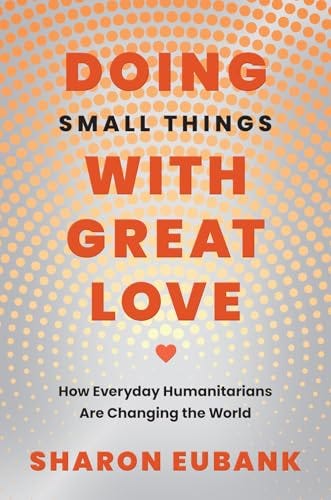
Doing Small Things with Great Love by Sharon Eubank
Format: audio
How I came to this book: Sharon Eubank leads the humanitarian aid arm of my church and is beloved and respected by many. I was looking for a bit of inspiration and found it here.
Review: Sharon Eubank is an icon. This book clearly comes from a place of experience and of love. Her decades of practical knowledge of the pitfalls and success stories of humanitarian aid (and thus pragmatism about what works, ie not just good intentions) pairs well with a sincere desire to help individuals find ways to make a difference in others’ lives and their own communities. She provides a lot of self-reflective food for thought and useful ideas about service as a lifelong learning process and building of relationship rather than a box to check. It sometimes veers a little into sentimental territory that might not work as well outside of the religious audience for which it’s primarily (but not solely) written, but like I said, the underpinning of experience helps the insights land.
Oh—and I got to go to a book club which Sharon Eubank attended and she was just as gracious and assured in (online) person :) Not long after, I felt motivated to go to a community involvement night in Provo, learned about a range of organizations, and got involved with Grow the Flow, an advocacy group for water conservation in the Great Salt Lake watershed.
Place factor: Factored into anecdotes from the field and the concept of proximity and global networks, but otherwise not central.
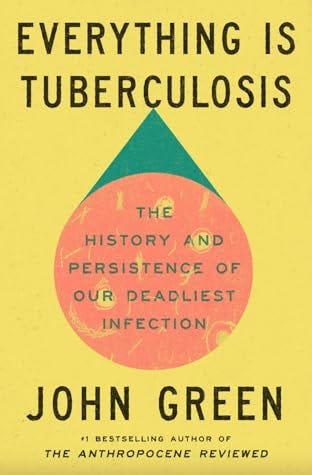
Everything is Tuberculosis by John Green
Format: audio
How I came to this book: It’s hyper-popular, and for good reason. I wanted to continue my non-fiction kick and so finally picked it up.
Review: John Green is making such excellent use of his fame and storytelling abilities. This functions really well as a readable introduction to the problem of tuberculosis and uneven global aid with a strong core of concrete, empathy-generating human stories, and a persuasive thesis that the central problem is injustice and the goal is shared human dignity. Consider my heart wrung through a wringer. Hard to think about this stuff in the even worse international climate than the time of publication.
Place factor: similar to Sharon Eubank’s book.
Novels
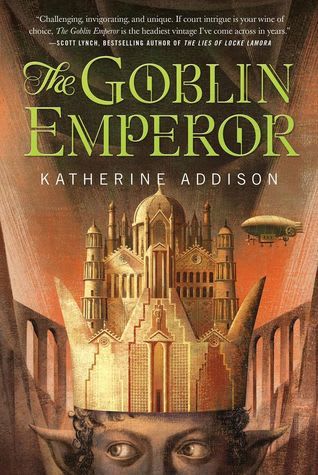
The Goblin Emperor by Katherine Addison
Format: audio
How I came to this book: evangelized to me by several reading friends 😊
Review: The Goblin Emperor is a YA fantasy novel that is also one of the more thorough and delightful instances of political worldbuilding that I’ve read, yet really centered on the emotional world of the main character. A coming of age story via unexpected emperorship. On audio, the names and characters were more difficult to follow than any Russian novel I’ve read, but it was enjoyable nevertheless. The narrative style was sometimes a little overly thorough, verging on repetitive, but intelligent.
Place factor: As a work of worldbuilding, place was important, though mostly in the sense of intricate palace layouts, lands of exile, and maps of the empire.
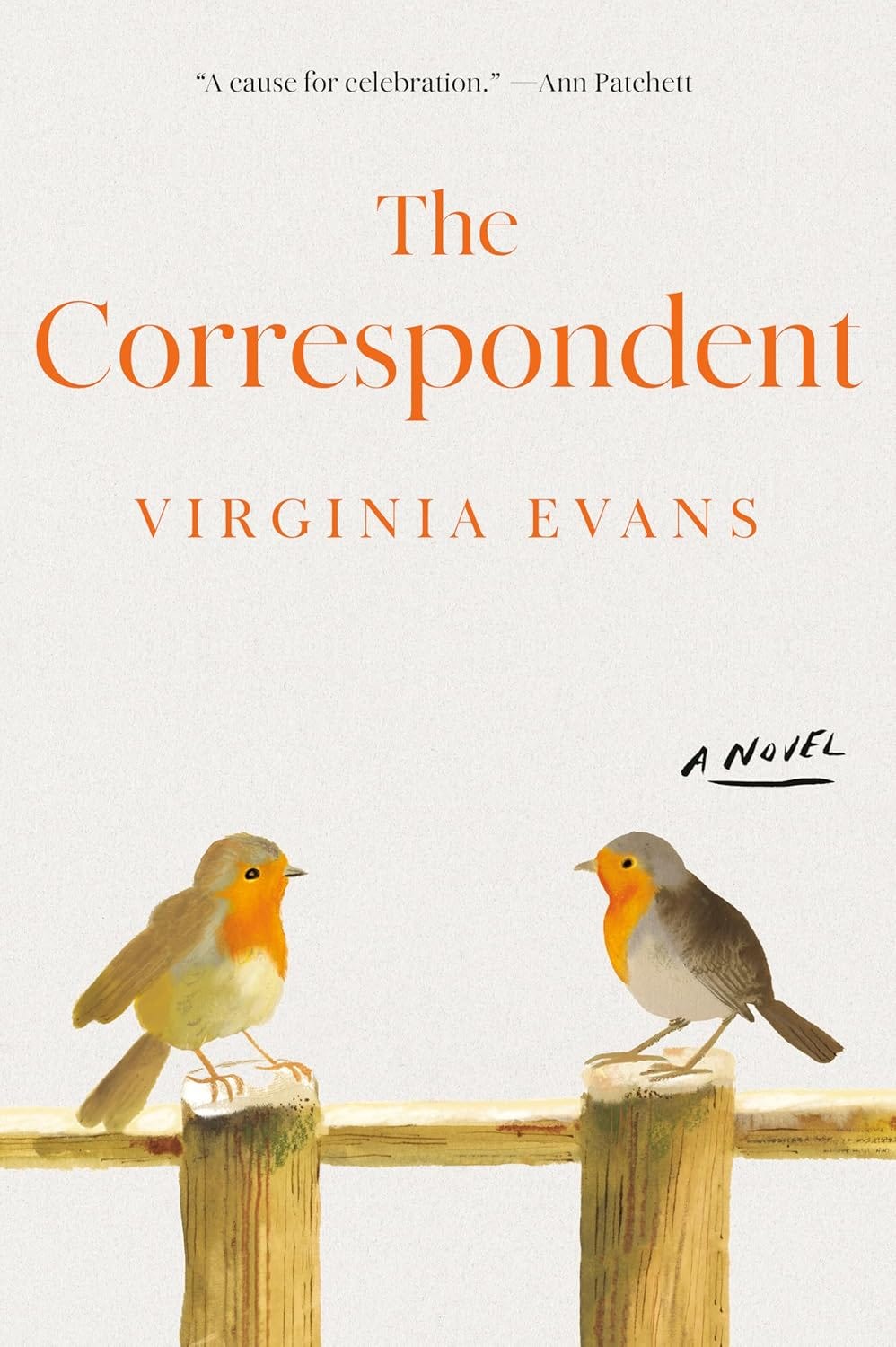
The Correspondent by Virginia Evans
Format: ebook
How I came to this book: hyper-popularity and evangelism by friends. It takes me a while to get on bandwagons since I’m naturally a bit resistant to them, but I finally decided to see what the fuss was about.
Review: The Correspondent, an epistolary novel in the voice of a feisty, aging woman, was sweet, fun, and tearjerking, though definitely a light read and I sometimes skimmed Sybil’s more narration-heavy letters (read in one sitting). Sybil reminds me of a few women I know.
Overall, not sure how memorable the book will be for me.
Place factor: a nice presence of a genteel Maryland neighborhood, not much else.
In February and March I also read the first four books of the Unselected Journals of Emma M. Lion series, a bandwagon I was long resisting and have been gradually won over by. I’ll review the whole series in the next post.
Short stories
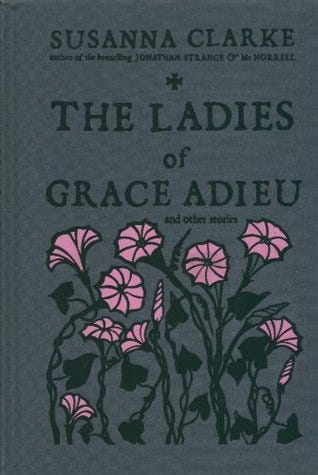
The Ladies of Grace Adieu by Susanna Clarke
Format: printed
How I came to this book: I’m a super-fan of Clarke’s Piranesi and also enjoyed Jonathan Strange and Mr Norrell. When I saw this collection at the library I decided it was time to dip back into that universe.
Review: Some of these stories grabbed me more than others but overall this is a fun, light re-immersion in the strange and wonderful mirror world of England that Susanna Clarke has woven out of mythology, landscape, history, and imagination (as seen in Jonathan Strange and Mr Norrell). I can never quite get fully into the pastiche trick of spelling words as they would have been in 1780 or 1811, but it’s certainly a choice.
Note: I also found The Wood at Midwinter, a standalone short story of Clarke’s, at the library and read it, but didn’t log it separately. It was beautifully illustrated but not the strongest story on its own.
Place factor: Place is central to Clarke’s works—in fact she’s one of the most effective and inventive place writers out there, grounding her fantasy in a nostalgic, immersive, dark-cornered England that feels like it might just smother you in lush, insidious vegetation if you turn your back for too long.
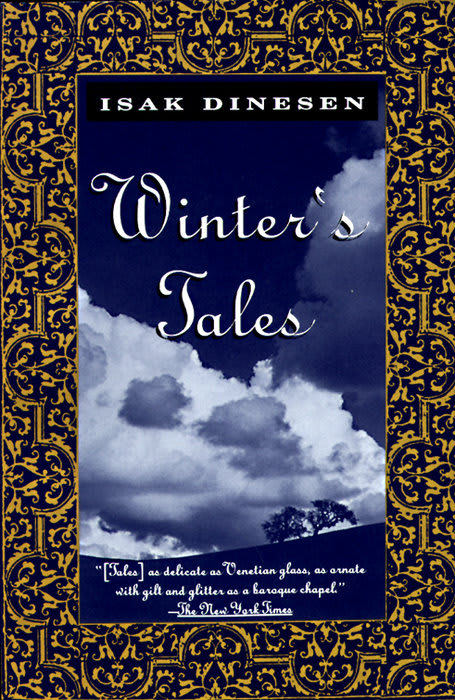
Winter’s Tales by Isak Dinesen
Format: ebook
How I came to this book: My family has strong ties to Denmark, and my parents have many of Isak Dinesen (pen name of Karen Blixen)’s books on their shelves, but I’ve never read any of them. My book group’s February theme was a book from a place you plan to visit soon, and my parents and I are visiting Denmark this summer, so after a recommendation from a friend, I chose Winter’s Tales.
Review: These tales were atmospheric and melancholic, with some truly beautiful passages—especially descriptions of the sea and the landscape. They often read like ambiguous fables, with a lofty omniscient narrator and stylized, oblique, philosophical dialogue. In fact most of the stories had some pivotal conversation or monologue that I could tell was at the heart of the story or character arc but had me scratching my head. That obliqueness made the stories hard to fully enjoy, but I’m still glad I read them.
Place factor: Place had a strong presence in all of these stories, whether it was the fertile Danish countryside in fishing villages and fiefdoms, the quicksilver sea in high summer or locked in ill-fated ice, or sojourns to other countries such as Germany during the Franco-Prussian war.
Some lyrical passages I saved:
It was April, the sky and the sea were so clear that it was difficult to hold one’s eyes up against them—salt, infinitely wide, and filled with bird-shrieks—as if someone were incessantly whetting invisible knives, on all sides, high up in Heaven.
- The Sailor Boy’s Story
Far out, the light of the sun stole through the amorphous, blind clouds, and where it caught the sea, the surface of it glimmered like silver, as if innumerable shoals of fish were playing on the water. Half way out to the horizon a flight, a wedge of wild swans drew a white line, like a pearly breaker of the air, across the pale field of view.
- The Fish
Soberly, his brows knitted, he contemplated, as it were, his own bones upon the sand. The deep-water currents would pass through his eyes, like a row of clear, green dreams; big fish, whales even, would float above him like clouds, and a shoal of small fishes might suddenly rush along, an endless streak, like the birds tonight.
- Peter and Rosa
Poetry
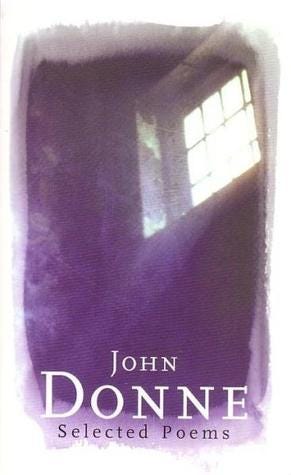
Selected Poems by John Donne
Format: printed
How I came to this book: My grandpa was a scholar of Early Modern English literature and my parents inherited a framed poster of Donne (once in the English department hallway, then Grandpa’s basement, now in our basement) with a blurb he wrote about him, which my eyes always glossed over as a kid. I read and was struck by a few poems in college, then bought this book at a used book sale in a churchyard in Cambridge several years ago, so it took me long enough to properly initiate myself to Donne—and now my grandpa isn’t here to talk about him.
Review: John Donne’s poems are often gnarly syntactical and metaphysical puzzles, but once you crack one it’s an utter delight (or a gut punch). Some of these I never did crack, but others were just dazzling. Also dizzying are all the different tones and personas Donne’s poetic voice takes on; he (or his narrator(s)) seems to be full of contradictions, which is itself sometimes an explicit theme in his poems. “As west and east / in all flat maps (and I am one) are one, / so death doth touch the Resurrection.” We have exquisite paeans to love and fidelity, we have bitter breakups tinged with misogyny, we have unabashed erotica, we have clever wordplay, we have deep sincerity, we have groveling before God, we have ecstatic communion with God, we have grappling with the ambiguities and uncertainties of spirituality in a physical world.
Meanwhile, a timeline of his life at the back of the book: after a whirlwind early political career, he married secretly for love, was punished for it, lived in poverty, and lost his wife Ann after she bore him 12 children in 16 years (and wrote a poem about it), lived 16 more years as a clergyman. I really must read a biography. (Update in June: am currently reading a biography! Super-Infinite by Katherine Rundell.)
Place factor: There are glimmers of place here, metaphorical mentions of maps and foreign countries and “O my America, my new-found land,” but I wouldn’t say it’s as central as more emotional and metaphysical landscapes.
Dark whimsy
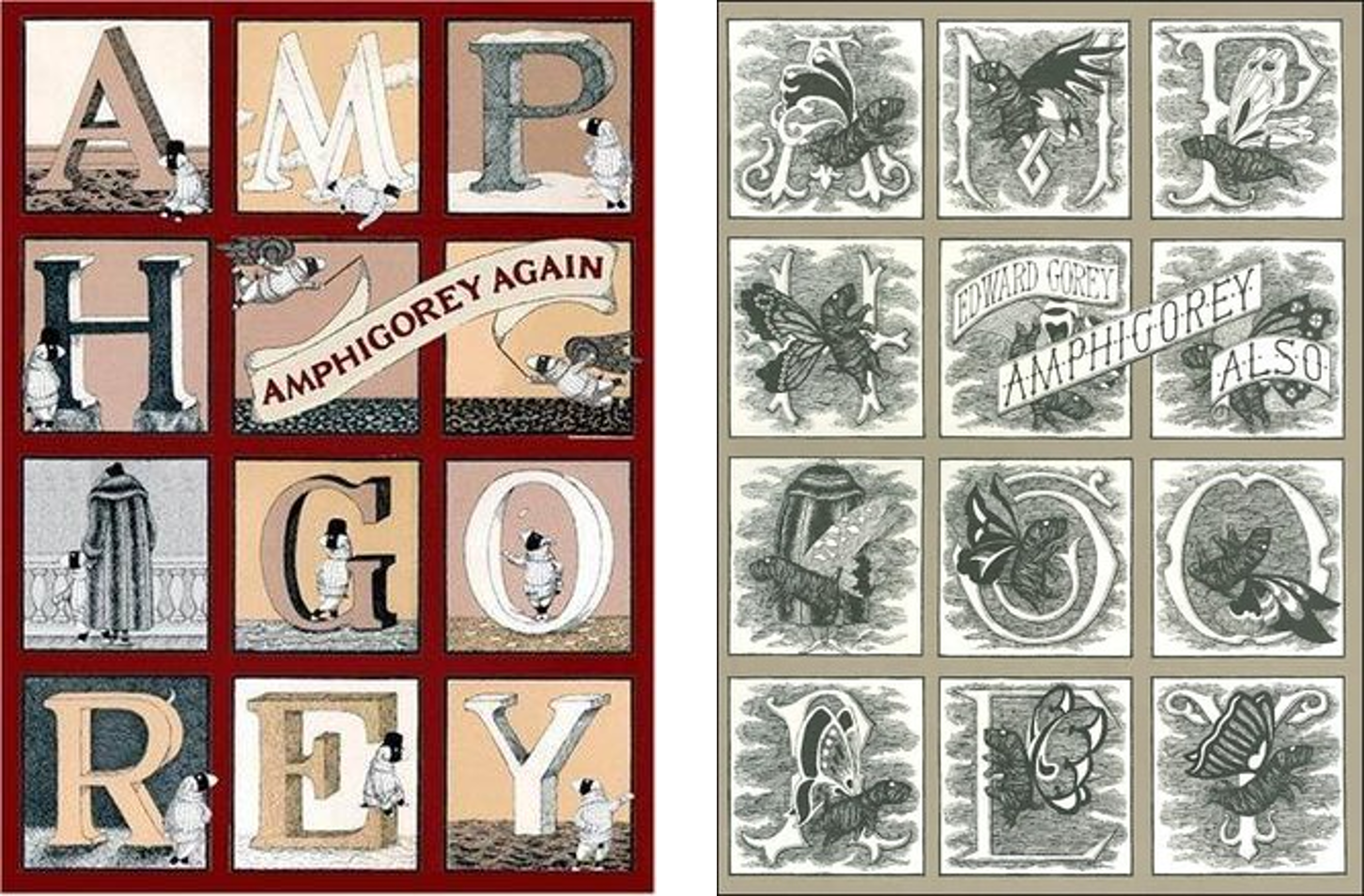
Amphigorey Again (#4) and Amphigorey Also (#3) by Edward Gorey
Format: printed
How I came to these books: Edward Gorey’s darkly whimsical illustrations have lurked in my awareness since childhood, and more recently my friend Rebekah King did an excellent series on her Substack about Gorey. I saw one of these anthologies of his work—the last one in the series, by coincidence—at the library and snatched it up, then checked out the only other one they have (thus reading in reverse order). I’ll probably buy the first two at some point.
Reviews:
Amphigorey Again was very fun and very random. Apparently the previous 3 collections are better since the last anthology this was sort of the scrapings, but in some ways starting with the last collection of random stuff feels fitting for reading Gorey.
Amphigorey Also: There is really nothing else like Gorey’s style. He has a set of tropes and motifs he works within (unsettling Victorians wearing fur coats, deadpan children, eldritch creatures with ridiculous names, slinky black dogs, sentient bicycles, ghastly out-of-frame crimes, noir mysteries you can’t quite follow, quippy and whimsical abecedaria, tragic tales that take bathos to the extreme) but his imagination is so incredibly nonsequitur that you always end up surprised.
My favorite tale was “Les passementeries horribles” in which giant elaborately brocaded tassels loom behind people in everyday settings—the most unexpectedly ominous objects I’ve ever seen. (See this fun review by the TikTok patron saint of tassels: https://youtube.com/shorts/UQAkXtYSrM...)
I also quite like the ethereal people with prunes for heads. And The Sopping Thursday—very elegant.
A previous library patron left their checkout slip in the book and this title was listed amidst exclusively children’s books, and I winced for the unsuspecting parent—there’s some seriously dark stuff in some of the stories in this one. It will have either gone over that kid’s head or scarred him/her forever.
Place factor: Gorey has his own special brand of dark, strange, banal Victorian place—see review.
Phew!
Stay tuned for my April-May reads, and then hopefully I’ll be on track to start recapping more regularly. Happy reading!
Deleting Instagram was also inspired by a dream/nightmare I had about being trapped in a barren commercial desert of a virtual reality and wanting desperately to return to the beautiful, dangerous real world…amazingly effective.
I love your book recaps! Thank you for doing these. The Darwin one sounds interesting…
Thank you for putting Darwin at the top. I believe that every educated person needs to read Origin of Species, and not only scientists. It is a profoundly important book and surprisingly easy to read.